The UCA International Users Group has presented an update on this work. Its main tasks include aligning UML modelling approaches, harmonizing data types, evolving the SCL model, applying formal validation rules and creating machine-readable mappings between CIM and IEC 61850.
Why CIM and IEC 61850 need to be harmonized
CIM and IEC 61850 are used at different but interrelated levels of power system automation. CIM is primarily intended to represent the power system and to exchange data between information systems, including control centre, network analysis and enterprise applications. IEC 61850 describes the information models of automation devices and functions, while the SCL language is used to describe the system configuration, primary equipment, functions and communication links.
In practice, the same substation may appear both in a CIM network model and in an IEC 61850 project containing SSD or SCD files. A circuit breaker in these models may represent the same physical piece of equipment. For software to make use of this relationship, it has to be defined unambiguously and maintained as the project changes.
The foundations of this interaction are set out in IEC TS 62361-102:2018. The technical specification addresses information exchange between IEC 61850 systems and systems that use CIM, and proposes changes to the information models to support such exchange.
The current work takes this approach further: mappings between the models are to be expressed in a form that engineering tools can process automatically.
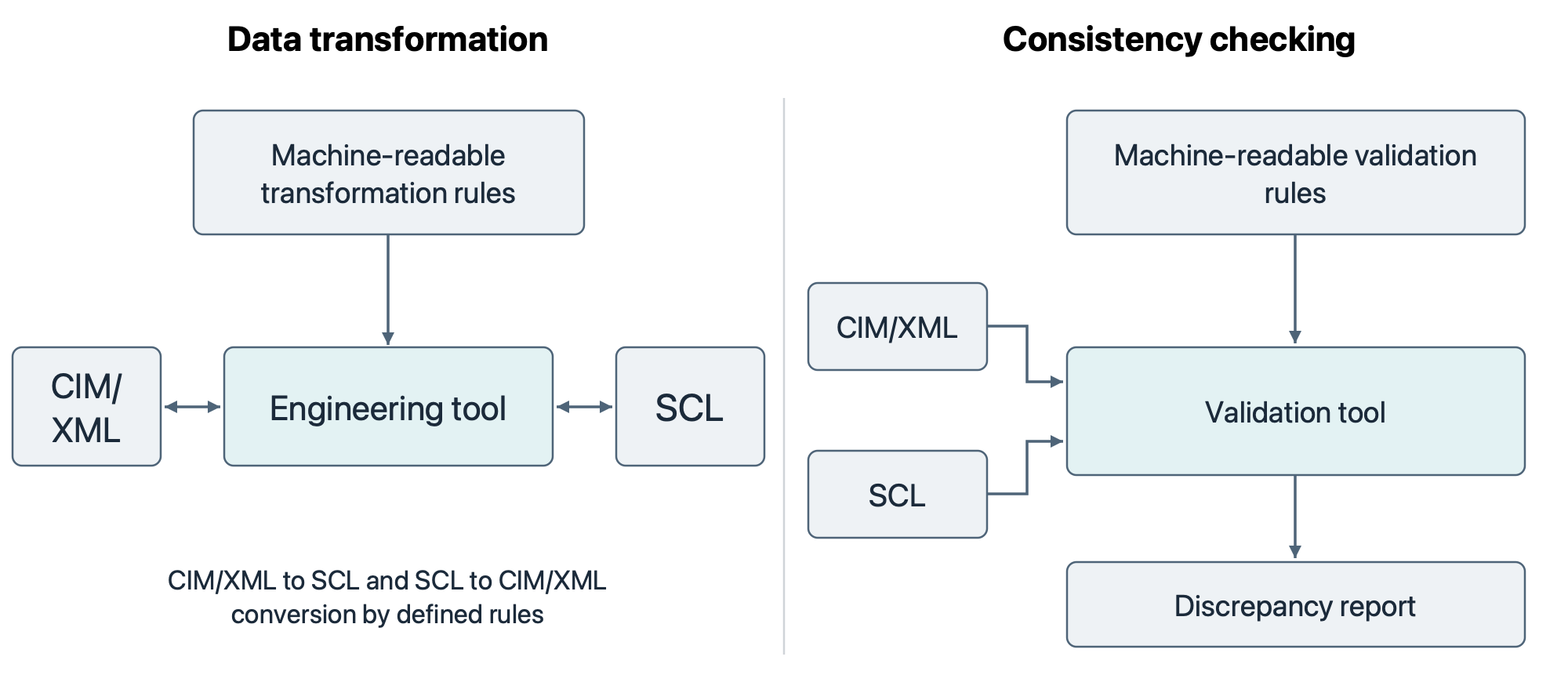
Automatic transformation between CIM and SCL
The first scenario in the diagram published by UCA is automatic transformation of model instances. A software tool takes data in CIM/XML and, based on formal rules, produces the corresponding SCL data. Transformation in the reverse direction is also envisaged.
The two models may differ in their level of detail. For example, CIM describes primary equipment and its electrical connections, while in SCL the same object is additionally linked to automation functions and intelligent electronic devices. What can be transformed therefore depends on the content of the source data and on the mapping rules. Any missing engineering information will have to be specified separately.
Among the possible means of describing mappings and transformations, the UCA materials mention QVT, XSLT, LinkML and SKOS. These technologies serve different purposes; on the diagram they illustrate the approaches under consideration rather than an approved single transformation mechanism.
The practical point is the reuse of formalized rules. If different tools rely on agreed rules, transformation results are easier to reproduce and verify.
Automatic model consistency checking
The second scenario covers checking two existing data sets, such as a CIM model and an SCL file. The software determines whether the information about the same object is consistent, taking into account the differences in the level of detail of the models.
The published diagram uses topology and electrical connections as an example. As the corresponding rules are developed, this approach can be extended to other information:
- the set of primary equipment and how it is represented in both models;
- object identifiers and whether they are correctly matched;
- phase designations and the electrical connections of equipment terminals;
- the links between equipment and measurements and control commands.
The result is a report of the discrepancies found. The UCA materials name OCL and SHACL for formally describing consistency conditions. Engineers can check the defined conditions programmatically and then investigate the inconsistencies that are identified.
What changes are proposed for SCL
The substance of the work can be seen in the public list of WG10 proposals. The harmonization topics include extending the list of equipment type codes, an additional description of the power system resource type, introducing an mRID identifier for equipment, terminals and connectivity nodes, and aligning phase designations with the CIM model.
Other proposals concern the unambiguous representation of unconnected terminals and adding the necessary data objects to measurement classes. These are registered directions for the evolution of the models; the existence of a proposal does not mean that it has already been included in the current edition of the standard.
The question of identifiers is particularly telling. CIM uses the mRID to identify objects. Using consistent identifiers in CIM and SCL helps software establish which elements of the two models refer to the same object. This kind of matching is more reliable than relying only on equipment designations, which may differ between systems.
Harmonization also covers measurements and control
On the CIM side, the lists of harmonization proposals address the representation of auxiliary equipment, the use of IEC 61850 data object names to define measurement types, and measurements that contain several values, including vector quantities.
It is also proposed to support a direct link between an intelligent electronic device and a measurement value, to define a standard set of control command types and to harmonize the model of discrete commands such as "raise" and "lower". These topics show that harmonization covers both the description of equipment and the automation data associated with it.
Of interest for digital substation engineering is the proposal to add automation equipment and function block entities to CIM to enable CIM-to-SSD transformation. The SSD (System Specification Description) is the file used in the early stages of IEC 61850 engineering.
Such an evolution of the model could make CIM one of the sources of input data for preparing the SSD and for the subsequent design of the automation system. How much information can be transferred automatically will depend on the content of the source model and on the agreed transformation rules.
Separating the SCL model from the XML format
Another line of work concerns the architecture of SCL. In engineering practice, SCL is usually associated with ICD, SSD, SCD and CID XML files. Yet it is the information model that defines the structure and meaning of the data, while XML is merely a way of writing them down.
The update describes a move towards a formal representation of SCL in UML, the Unified Modeling Language. XML schemas can be generated from such a model, and the model can be used for automatic data validation.
This makes it possible to evolve the model and its machine-readable representations consistently. XML keeps its role in SCL, while the formal description of the model lays the foundation for supporting other formats in the future.
Machine-readable SCL validation rules
In 2025, IEC TS 61850-6-3 was published. This technical specification describes the format and method for writing formal validation rules for IEC 61850 XML files using OCL, the Object Constraint Language. Such rules can be imported and executed by software tools.
The document provides for checking SCL at various stages of specification and engineering, checking files after conversion between SCL versions, and supplementing the standard rules with an organization's or a project's own rules.
The specification itself defines how rules are to be written. The rule sets are published as machine-readable components of the relevant parts of IEC 61850. This makes it possible to formalize some of the requirements and to apply the same checks in different engineering tools.
What this changes for the digital substation
In a digital substation project, data pass through several information representations: the network model, the system specification, the automation design and the device configurations. Transferring information manually introduces discrepancies that may go unnoticed until commissioning or operation.
Consistent identifiers, formal transformation rules and automatic checks make it possible to control the links between these representations. For example, after a change in the equipment or in the connection diagram, one can check whether the change is reflected in the related models.
The practical result will depend on how complete the rules are and on how well software tools support them. With such support, harmonizing CIM and IEC 61850 can reduce repeated data entry and make model consistency checking a routine part of engineering. At the same time, automatic checking confirms only that the defined rules are met; its coverage is determined by which information and constraints have been formalized.