On 15 October 2026, the 28th General Conference on Weights and Measures (Conférence générale des poids et mesures, CGPM), meeting in Versailles, adopted Resolution 5: from 20 May 2027, Coordinated Universal Time (UTC) becomes continuous [1]. Leap seconds, which since 1972 have kept UTC within 0.9 seconds of the time defined by the Earth's rotation, will no longer be inserted. The permitted difference between the two has been widened to 3,600 seconds, or one hour, which the CGPM expects to keep UTC continuous for several centuries [1].
Back in 2022 the CGPM decided to widen this tolerance in, or before, 2035 [2]. The date was brought forward on the proposal of the Consultative Committee for Time and Frequency (CCTF): the Earth has been rotating faster in recent years, raising for the first time the possibility of a negative leap second, something never applied in the history of UTC [3].
Atomic clocks reproduce the second with enormous accuracy, so why did civil time ever need whole seconds added to it? The answer lies in the difference between three time scales.
From the Earth's Rotation to the Atomic Second
For thousands of years the Earth's rotation was the natural reference for time. Day and night gave the length of the day, and the position of the Sun gave the time within it.
As astronomy developed, it became clear that the Earth does not rotate perfectly uniformly. Its rotation is affected by the tidal forces of the Moon and the Sun, atmospheric motion, ocean currents and processes inside the planet. Over the long term, tidal interaction with the Moon gradually slows the Earth's rotation.
In the 20th century it became obvious that measuring the Earth's actual rotation and reproducing uniform time intervals had to be separated. Practical atomic clocks appeared in the 1950s; in 1967 the second of the International System of Units (SI) was defined through a transition of the caesium-133 atom; and in 1972 the present UTC system with leap seconds came into force.
Today three time scales share this job: Universal Time UT1, which reflects the Earth's actual rotation; International Atomic Time TAI (Temps Atomique International), a uniform atomic scale; and Coordinated Universal Time UTC, which reconciles the two.
UT1: Time as Shown by the Earth's Rotation
UT1 is tied directly to the actual rotation of our planet. It is determined by Very Long Baseline Interferometry (VLBI).
Radio telescopes at different points on the Earth simultaneously observe distant quasars, active galactic nuclei that serve as practically fixed reference points in the sky.
A radio wave from a single quasar reaches the different antennas with a small delay. That delay depends on the orientation of the line between the telescopes relative to the source. As the Earth rotates, the orientation changes, and the delay changes with it (Fig. 1).
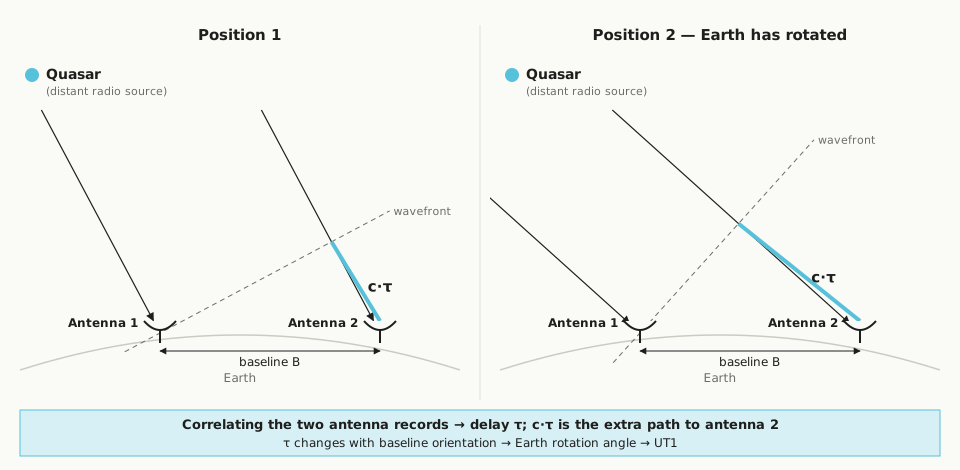
By combining many observations, scientists determine the Earth's orientation, including its rotation angle. UT1 is thus obtained directly from astronomical measurements rather than from an assumption that the Earth always rotates at the same rate. The values of UT1 − UTC derived from these observations are published by the International Earth Rotation and Reference Systems Service (IERS), which was also the body that announced leap seconds.
TAI: Time Counted by Atoms
International Atomic Time is based on atomic frequency standards. The SI second is defined through the transition between two hyperfine levels of the ground state of the caesium-133 atom; the corresponding frequency is 9,192,631,770 Hz.
The frequency of an atomic transition is set by the properties of the atom itself, not by the design of the clock. Under identical conditions caesium-133 atoms show the same resonance, although real instruments have to account for external fields and other effects.
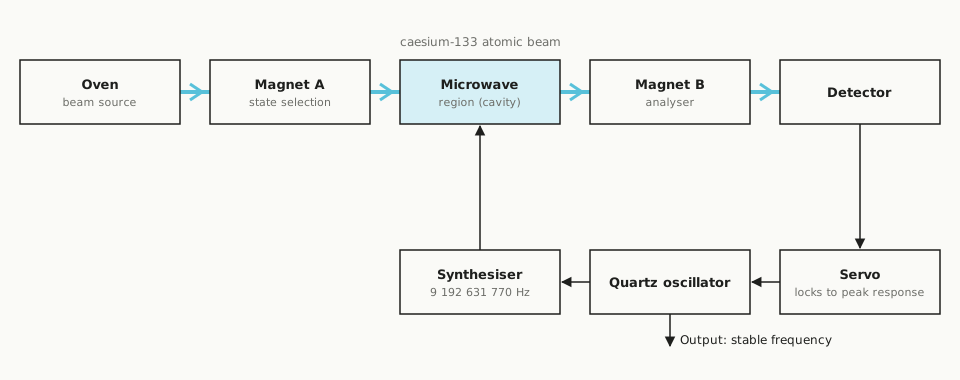
In a classical caesium clock, a heated source produces a beam of atoms. A magnetic field selects atoms in particular states, which then pass through a microwave interaction region. When the oscillator frequency matches the transition frequency, the probability of a change of state increases.
A detector measures what fraction of the atoms has changed state, and the electronics tune the oscillator to the maximum of the resonance response (Fig. 2). International Atomic Time is formed from the readings of many atomic clocks in different laboratories and is a continuous, uniform scale.
UTC: Atomic Seconds Corrected for the Earth's Rotation
UTC uses the same length of second as TAI but has historically been kept close to UT1. To do this, leap seconds were inserted into UTC whenever the accumulated difference approached the set limit.
The normal sequence at the end of a day is 23:59:58 → 23:59:59 → 00:00:00. With a positive leap second it becomes 23:59:58 → 23:59:59 → 23:59:60 → 00:00:00 (Fig. 3).
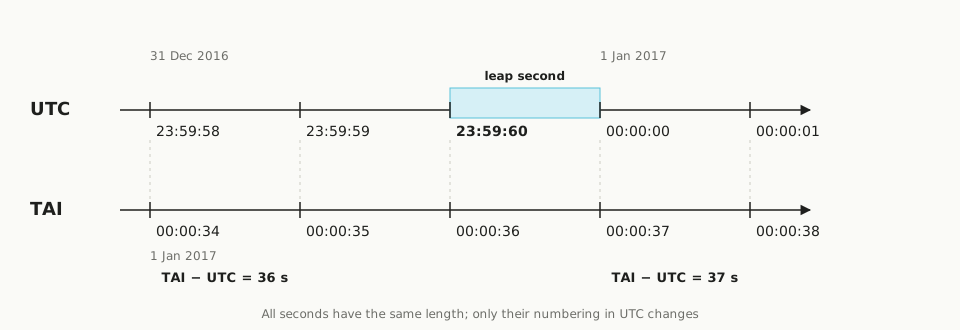
TAI, meanwhile, runs on without such insertions. Since 1 January 2017, TAI − UTC has been 37 seconds [4]. This is not a clock error; it is a difference in how the same instant is represented numerically.
The second inserted at the end of 2016 turned out to be the last: there will be no correction at the end of 2026 [4], and the next possible date, the end of June 2027, already falls within the period of continuous UTC. In total, 27 leap seconds were inserted after 1972, and all of them were positive. TAI − UTC will stay at 37 seconds.
A leap second has nothing to do with 29 February: the extra calendar day keeps the calendar aligned with the seasons, not the count of seconds.
Why Leap Seconds Trouble Computers
Many programs assume that every minute contains exactly 60 seconds numbered 00 to 59. Inserting the label 23:59:60, repeating a time stamp or handling the correction inconsistently can break event ordering and interval calculations.
Some systems use a leap smear: the correction is spread over a longer interval by slightly changing the clock rate. Since 2008 Google has smeared the extra second over 24 hours, linearly from noon to noon UTC, which slows clocks by about 11.6 parts per million (ppm) [5]. Other operators use different intervals and different smear shapes. Smearing avoids an instantaneous insertion, but systems with different handling rules temporarily disagree; the CGPM resolution explicitly notes that the variety of such methods leads to inconsistent timing between systems [1].
The CGPM decision removes the need for such corrections on a regular basis. Abandoning leap seconds does not, however, abolish UT1, TAI or UTC, nor does it remove the requirement to interpret time correctly.
What Changes After the Reform
Widening the permitted difference between UTC and UT1 means that small changes in the Earth's rotation rate will no longer require regular insertions or deletions of seconds. The astronomical scale UT1 will continue to be measured for science, geodesy and navigation.
Over time, civil clocks may slowly drift away from solar time. But the periods involved are very long, and the rate at which the difference accumulates depends on the Earth's actual rotation.
Time Scales in a Digital Substation: Synchronisation Protocols and IEC 61850 Time Stamps
Consider a typical architecture with a main and a backup precision time source. The Supervisory Control and Data Acquisition (SCADA) server is synchronised over the Network Time Protocol (NTP), while protection and control relays and merging units (MU) receive time over the Precision Time Protocol (PTP), for example using the IEC/IEEE 61850-9-3 Power Utility Profile [6] (Fig. 4).
The SCADA system records its own events and receives messages from the relays carrying their time stamps. For example, a protection relay records a trip, and SCADA records the change in circuit-breaker position. To reconstruct the sequence of events, the two time stamps must be comparable.
flowchart TB
    subgraph STN["Station level"]
        GMS["Precision time sources<br/>main + backup"]
        SCADA["SCADA server<br/>event log"]
    end
    subgraph BAY["Bay level"]
        IED["Protection relay"]
        MU["Merging unit (MU)"]
    end
    GMS -- "NTP: UTC" --> SCADA
    GMS -- "PTP: TAI scale + currentUtcOffset = 37 s" --> IED
    GMS -- "PTP" --> MU
    SCADA <-- "MMS reports: TimeStamp (UTC) + TimeQuality" --> IED
Fig. 4. Time paths in a substation: the SCADA server receives UTC over NTP, while protection relays and merging units receive the TAI-based PTP scale together with the offset to UTC. Event time stamps in the SCADA log have to end up on a single scale.
The PTP power profile uses the continuous PTP timescale, which is aligned with TAI; NTP is normally tied to UTC. Different protocols do not mean that devices have to show different civil time, though. The PTP timescale counts TAI seconds from the epoch of 1 January 1970, and the grandmaster carries the currentUtcOffset field (currently 37 s) and the leap61/leap59 flags, which warn of an upcoming correction, in its Announce messages [7]. A device subtracts the offset and obtains UTC. After 20 May 2027, currentUtcOffset will remain at 37, and the flags will no longer be set.
An IEC 61850 time stamp (TimeStamp) is UTC: seconds since 1 January 1970 and a fraction of a second, plus a TimeQuality byte carrying the LeapSecondsKnown, ClockFailure and ClockNotSynchronized flags and the TimeAccuracy value. Amendment 1 to IEC 61850-7-2 (2020) also covers the worst case: if a device in holdover cannot determine whether a leap second occurs at midnight, it sets ClockNotSynchronized at midnight and keeps it set until synchronisation is restored [8]. In the SCADA log, such events will carry time stamps marked as coming from an unsynchronised clock, even though the clock itself may have drifted only slightly.
Errors in interpreting the offset or in handling a leap second can make logs disagree even when the clocks themselves are well synchronised to their sources. Abandoning regular leap seconds removes one such transitional risk, but it does not remove the need to reconcile time scales.
Synchronisation Accuracy and Unambiguous Time Stamps Are Different Problems
The history of leap seconds shows that synchronisation accuracy and correct representation of time are different problems. A digital substation needs both: device clocks must run in agreement, and their time stamps must be interpreted unambiguously throughout the system.
Abolishing leap seconds removes one transitional mode, but not the need to check how SCADA, relays and recorders convert PTP, NTP and the IRIG-B (Inter-Range Instrumentation Group, format B) time code to UTC: that is where logs drift apart.
Sources
- CGPM, Resolution 5 (2026), "On the technical actions needed to ensure the continuity of UTC". https://www.doi.org/10.59161/CGPM2026RES5E
- CGPM, Resolution 4 (2022), "On the use and future development of UTC". https://www.bipm.org/en/-/resolution-cgpm-27-4
- Statement by the CCTF President, 28th meeting of the CGPM (2026). https://www.bipm.org/documents/d/guest/statement-cctf-president-cgpm-2026
- IERS, Bulletin C 72, 6 July 2026. https://hpiers.obspm.fr/iers/bul/bulc/bulletinc.72
- Google, "Leap Smear". https://developers.google.com/time/smear
- IEC/IEEE 61850-9-3:2016. Communication networks and systems for power utility automation — Part 9-3: Precision time protocol profile for power utility automation.
- IEEE 1588-2019 / IEC 61588:2021. Precision clock synchronization protocol for networked measurement and control systems.
- IEC 61850-7-2:2010+AMD1:2020, TimeQuality. Excerpt: https://redmine.ucaiug.org/attachments/download/3278/61850-7-2%20pp45-47%20qualityFlags.pdf