The International Electrotechnical Commission has taken another step toward publishing a new part of the IEC 61850 series. On 4 September 2026, the IEC published Committee Draft 57/2980/CD of IEC 61850-8-3 — Communication networks and systems for power utility automation — Part 8-3: Specific Communication Service Mapping (SCSM) — Mapping to Direct Message Specification (DMS), JSON Encoding Rules, and WebSockets.
The project has moved to the Committee Draft (CD) stage and is now available to the IEC national committees for review and the preparation of comments. The commenting period for the document ends on 30 October 2026.
IEC 61850-8-3 is of particular interest because it offers a new way of mapping the communication services of IEC 61850, based on technologies widely used in modern software systems: WebSocket, JSON and ASN.1.
IEC 61850 gains a new communication mapping
For digital substation specialists, IEC 61850 client-server interaction is traditionally associated first and foremost with MMS, used in accordance with IEC 61850-8-1.
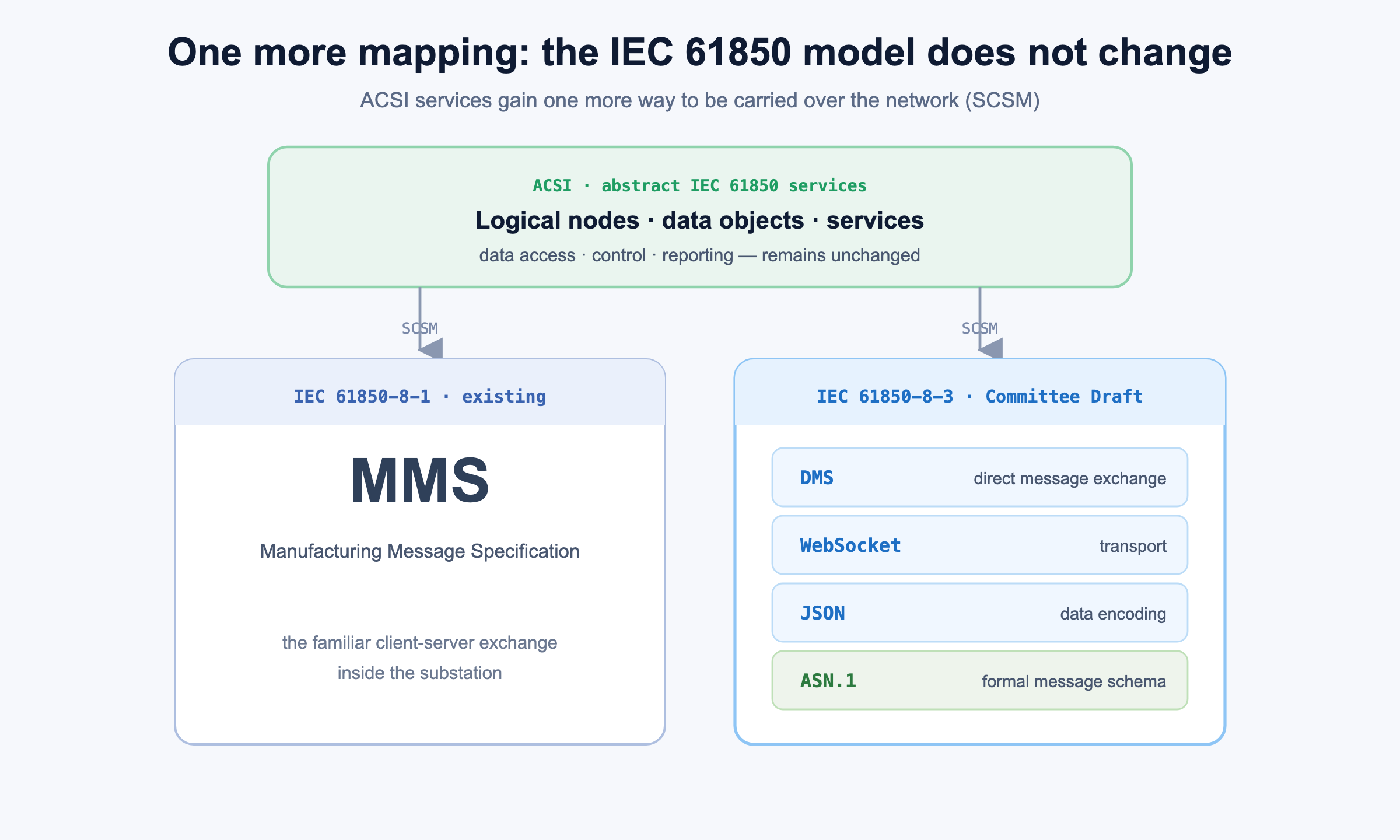
At the same time, the IEC 61850 architecture itself was designed from the outset to separate the abstract model of services from the specific way they are carried over the network. ACSI services — for example, data access, control and reporting — can be bound to a particular communication stack by means of a Specific Communication Service Mapping, SCSM.
IEC 61850-8-3 defines one more such mapping.
The new project uses several technologies at once:
- Direct Message Specification (DMS) — for organising direct message exchange;
- WebSocket — as the communication mechanism;
- JSON Encoding Rules — for representing data;
- ASN.1 — for the formal description of the message structure.
Thus, this is not about creating a new IEC 61850 information model, nor about replacing the existing logical nodes, data objects or services. The existing IEC 61850 model is preserved, while its services gain a new way of being mapped onto communication technologies.
The key role of ASN.1
One of the important elements of the published Committee Draft is the formal ASN.1 schema of the messages.
A normative annex of the project states that the protocol messages carried in the WebSocket payload are defined by an ASN.1 schema. The top level of the schema forms the structure of the application PDU, on the basis of which the messages and services are described.
ASN.1 here effectively becomes a formal description of the protocol: the schema defines the structure of the messages required to encode and decode them.
Moreover, the ASN.1 module is published separately among the supporting materials of IEC TC 57, which potentially makes it possible to use it directly in the development of software implementations.
From web technologies to a normative part of IEC 61850
The use of web technologies in IEC 61850 has been discussed for quite some time.
The evolution of power systems is gradually leading to IEC 61850 being used not only for the interaction of physical IEDs within a substation. An ever greater role is being played by server applications, centralised and virtualised protection and control functions, software gateways, higher-level systems and distributed computing platforms.
In such an architecture, there arises a need for communication mechanisms that are easier to integrate with modern software technologies.
WebSocket is of obvious interest in this respect. It is a widely supported mechanism for bidirectional data exchange, available in practically all modern operating systems, programming languages and software platforms.
IEC 61850-8-3 makes it possible to use such technologies without abandoning the IEC 61850 information model and services.
This is precisely the fundamental point: applications should not have to invent their own REST APIs or integration formats for IEC 61850 data on their own — the standard defines how the existing IEC 61850 services can be mapped onto the new communication stack.
An open implementation already exists
The development of the standard is accompanied by practical experiments as well.
As noted by Karlheinz Schwarz, one of the participants in the development of the document, the Committee Draft is based, in particular, on the Netbeheer Proof of Concept for RTI2. The Dutch organisation Netbeheer Nederland maintains an experimental implementation as an open-source project on GitHub.
The repository also publishes the ASN.1 schema used to implement IEC 61850 exchange over WebSocket. The version of the schema on GitHub is regarded as preliminary with respect to the official version accompanying the Committee Draft.
The existence of such an implementation matters not only to the developers of the standard. It makes it possible to begin practical experiments with the new SCSM even before the final edition of IEC 61850-8-3 is published.
IEC 61850 is becoming a standard not only for IEDs
The appearance of IEC 61850-8-3 fits well into the broader process of IEC 61850 development.
Initially, the standard was largely perceived as a communication technology between the intelligent electronic devices of a substation. Then IEC 61850 gradually became the basis of the information model of the digital substation, spread to new areas of the power industry and began to be used at different levels of automation.
Now a similar transformation is happening with the computing architecture.
Functions that were previously tightly bound to an individual physical terminal can gradually move onto shared computing platforms. Centralised and virtualised protection, software implementations of automation functions, server platforms and software-defined substations are appearing.
Under such conditions, it becomes important not only to standardise the data, but also to provide convenient, standardised ways of using it in modern software applications.
IEC 61850-8-3 may become one of the elements of this transformation: the IEC 61850 information model remains the same, but the number of ways of using it in the software infrastructure grows.
For now the document is only at the Committee Draft stage, so individual technical solutions may still change as a result of review by the national committees.
However, the very fact that IEC 61850-8-3 has reached the CD stage already shows the direction in which the standard is developing: IEC 61850 is gradually turning from a standard for the interaction of individual digital-substation devices into a common information and communication foundation for a software-defined power system.